
How Much Does a Retaining Wall Cost in Belton and Temple, TX?
November 11, 2026
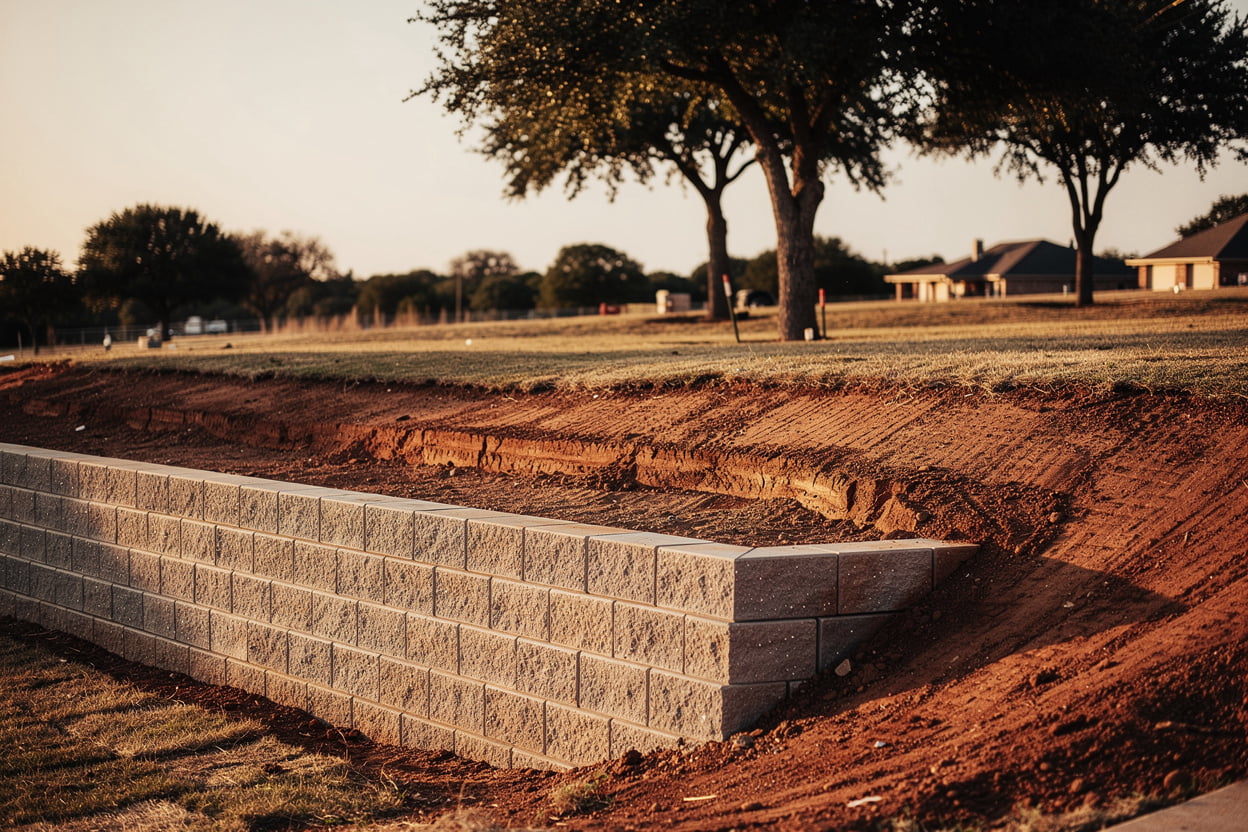
If you have a slope in the backyard that washes soil toward the house every time it rains, you've probably already started asking what a retaining wall would cost. The honest answer is that it depends, but the variables are predictable once you know what to look for.
What drives the price
Height is the big one. A wall under three feet tall on a stable, level base is a very different job from a six-foot wall holding back a bank with a driveway sitting on top of it. Taller walls need deeper footings, more reinforcement, and often engineered design, so the cost climbs faster than the height.
Material matters too. Segmental block (the interlocking concrete units you see in a lot of yards around Belton) is usually the most cost-effective for residential work. Natural stone looks great but costs more to source and set. Poured concrete walls are common on larger commercial jobs and some steep residential lots.
Drainage is the part people underestimate. Clay soil is everywhere in Central Texas, and it holds water. Behind every wall we build, there needs to be gravel backfill and a drain line at the base, or hydrostatic pressure will eventually push the wall out. That work adds real cost, but skipping it is how a $6,000 wall turns into a $15,000 rebuild.
Ballpark numbers
For a typical front-yard or backyard segmental block wall in the 3 to 4 foot range, many homeowners in this area land somewhere around $35 to $60 per square foot of face, installed. A short four-foot-high run of 30 linear feet might fall in the $5,000 to $8,000 range once excavation, base, drainage, and cap stones are included. Taller walls, tight access, or heavy tree roots to work around push that higher. These are ranges, not quotes. Every site is different.
Before you call anyone
Walk the wall line and note where water comes off your roof and where it pools. Take photos of the slope from the top and bottom. Know roughly how far the wall would run and whether you want it straight or stepped. If a tree sits close to the line, mention it up front, because roots and wall footings need to be planned together.
We design and install retaining walls for residential properties in Belton, Temple, and the surrounding area, and we're happy to walk the site with you before anything is decided. A site visit with clear photos and a rough sketch is usually enough to get a number you can plan around.